
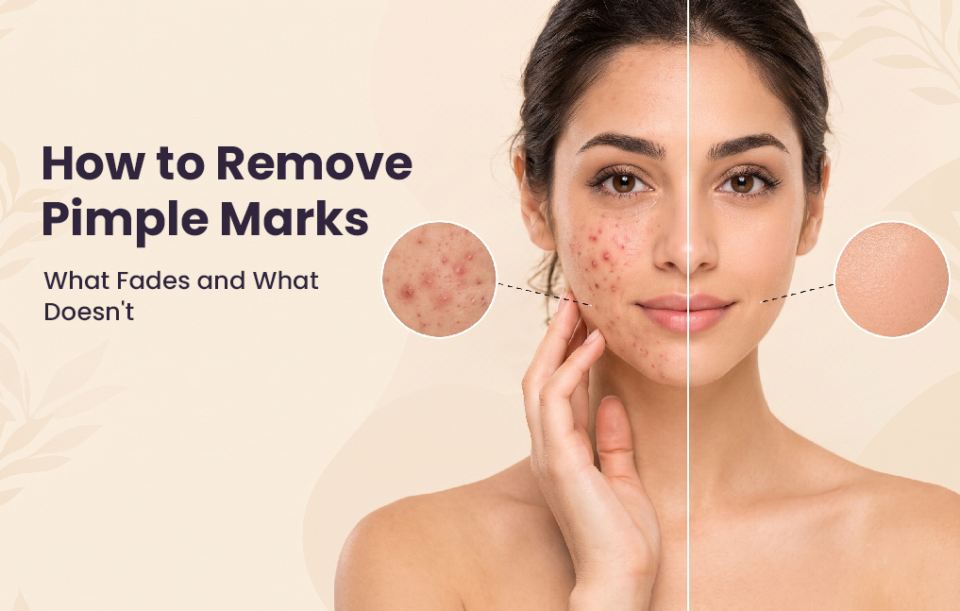


How to Remove Pimple Marks: What Fades and What Doesn’t?
Most people searching for how to remove pimple marks are actually dealing with one of two very different problems. Some have flat discoloration left behind after a breakout settled. Others have a change in the skin’s surface, a small dent or a raised bump where the pimple used to be.
In the mirror they can look almost identical. They respond to completely different treatments. Working out which one you have can save you months spent on products that were never going to work in the first place.
Marks or Scars? The Difference Decides Everything
There’s a simple test. Run a finger over the area, or tilt your face and look at it from the side instead of straight on.
A mark is flat. The surface is smooth and only the colour has changed. That’s pigment or blood vessel activity sitting in skin that has already finished healing.
A scar has texture. The surface is pitted, dented or raised, because the collagen structure changed while the skin was repairing itself.
Flat marks fade. Textured scars don’t. No cream, serum or home remedy changes skin texture, for the simple reason that the problem sits deeper than any topical product can reach.
| Flat marks | Textured scars | |
| How it looks | Red, pink or brown, smooth to touch | Pitted, dented or raised |
| What caused it | Pigment or widened blood vessels after inflammation | Collagen loss or overgrowth during healing |
| Fades on its own | Usually, over months | No |
| Responds to creams | Often, to some degree | No |
| Needs a procedure | Rarely | Usually |
Red Marks Left After a Pimple
That pink or red patch hanging around after a pimple settles is post inflammatory erythema. Blood vessels widened during the inflammation and simply stayed dilated for a while after the breakout itself cleared.
Acne redness of this kind usually settles on its own over a few weeks to a few months. Sun exposure slows it down. So does picking.
While it settles, what actually helps is unglamorous. Protect the area from the sun every day. Keep scrubs and strong actives off healing skin. Then leave it alone, which is the hardest part for most people. If red pimple marks are still obvious well past a few months, vascular laser can help, and that’s a conversation to have with a doctor rather than something to manage at home.
Brown Marks on Indian Skin
Brown or greyish brown pimple marks on the face are post inflammatory hyperpigmentation. The inflammation pushed the skin into producing extra melanin, and that pigment stayed behind once the pimple cleared.
This is far more common in Indian and other deeper skin tones, and it takes its time. Several months is completely normal. Sometimes it stretches past a year.
Daily sunscreen matters more here than any other single habit, because UV exposure deepens pigment that’s already there and drags out the fading. Wear it indoors too if you sit near a window.
Where marks are widespread or unusually stubborn, clinical pigmentation treatment options exist, including peels and prescribed topical protocols chosen after an examination.
Why Marks Last Longer on Indian Skin
Most Indian skin falls into Fitzpatrick types four and five. The melanocytes, the cells that make pigment, are simply more reactive. The same amount of inflammation that leaves a barely visible pink patch on paler skin can leave a distinct brown mark here, and hold onto it for far longer.
Two other things stack on top. Darker marks stand out against surrounding skin tone in a way that mild redness never does. And in a city like Mumbai, UV exposure doesn’t take a season off, so the pigment keeps getting stimulated.
There’s a practical consequence for treatment too. Aggressive peels and lasers carry a higher risk of triggering fresh pigmentation in deeper skin tones. A plan that works beautifully on lighter skin can genuinely make things worse here. That’s why skin tone gets assessed before anything is recommended.
What Helps Flat Marks Fade
With flat marks, you’re supporting a process the skin is already carrying out. You’re not forcing a result.
Sun protection does most of the heavy lifting. A broad spectrum sunscreen, applied daily and reapplied if you’re outdoors, stops existing pigment from deepening. Skip this and almost everything else you do gets undone.
A few topical ingredient groups have reasonable evidence behind them for pigmentation: niacinamide, azelaic acid, vitamin C and retinoids. Retinoids need introducing slowly, because irritation causes inflammation, and inflammation is what created the mark to begin with.
Some popular remedies actively work against you. Lemon juice is acidic and photosensitizing, so it often deepens pigment instead of lightening it. Toothpaste irritates the skin. Hard scrubbing drags inflammation out rather than cutting it short. And steroid containing skin lightening creams, which are sold far too easily in India, can cause thinning and rebound pigmentation with long use. That’s a much harder problem to fix than the mark you started with.
Can a Pimple Be Removed Overnight?
No. A pimple is an inflamed follicle, and inflammation takes days to settle. Articles promising to remove a pimple overnight are really describing ways to make one less noticeable.
What does help in the short term:
- A cold compress held on the spot for a few minutes, which brings down pimple swelling and discomfort
- Leaving it completely alone, since squeezing is the single biggest cause of marks and scars
- A hydrocolloid patch, mostly because it physically stops you touching the area
For a large, painful pimple before an important day, a doctor can inject a small dose of corticosteroid directly into it. That usually settles the inflammation within a day or two. It’s a clinic procedure, not a home experiment.
Deep Pimples Carry the Highest Scar Risk
Those painful pimples under the skin that never come to a head are nodules or cysts. They sit deeper, last longer, and they’re the type most likely to leave permanent texture change behind.
If you get these regularly, treating each one as it shows up isn’t the answer. Persistent nodular acne needs proper medical management, and getting it under control early is what prevents scarring later. Once scars have formed, the goal shifts from prevention to correction, and correction is slower, costlier and more involved.
When Marks Turn Out to Be Scars
Acne scars aren’t all the same, and the type decides the approach.
| Scar type | How it looks | Approaches commonly used |
| Ice pick | Narrow, deep pits | Punch excision, TCA CROSS |
| Boxcar | Wider depressions with defined edges | Microneedling, resurfacing, subcision |
| Rolling | Broad, wave like dips in the surface | Subcision, fillers |
| Hypertrophic | Raised, stays within the original boundary | Steroid injection, silicone therapy |
| Keloid | Raised, spreads beyond the original spot | Specialist assessment |
Depressed scars are treated by stimulating new collagen or releasing the tethered tissue sitting underneath. That usually means microneedling, subcision, laser resurfacing or dermabrasion, across several sessions and often in combination.
Which approach suits you comes down to scar type, depth, your skin tone and how much of the face is involved. This is exactly why an acne scar treatment assessment matters more than picking a procedure off a list.
Raised and keloid scars behave differently from depressed ones and follow a separate path altogether.
How Long Does It Take?
Timelines vary from person to person, but rough expectations help you judge whether something is actually working.
Red marks commonly settle within a few weeks to a few months. Brown marks take longer, often several months and sometimes beyond a year. Treatment shortens that wait to a degree rather than removing it.
Scar procedures work on a different clock. Collagen remodeling is slow, so results build over the weeks and months after a session instead of showing up immediately, and most approaches need a course of treatments spaced several weeks apart. Anyone promising a one session fix for textured scarring is describing something the biology doesn’t support.
How to Stop Marks Forming in the First Place
- Don’t pop, squeeze or pick. This is the main cause of both marks and scars.
- Use sunscreen daily and reapply if you’re outdoors.
- Treat active acne early instead of waiting for it to sort itself out.
- Skip the harsh scrubbing. It prolongs inflammation rather than shortening it.
- See a doctor for deep or painful lesions instead of waiting them out.
Frequently Asked Questions
How long do pimple marks take to fade?
Red marks usually settle within a few weeks to a few months. Brown marks on Indian skin commonly take several months, and sometimes longer than a year.
Pimple ke daag kaise hataye?
Flat marks usually fade with consistent sun protection and time. If the area feels dented or raised rather than flat, it’s a scar rather than a mark, and it needs a clinical procedure.
Do home remedies remove pimple marks?
Some ingredients may help flat pigmentation fade a little faster. None of them change skin texture, so they do nothing for pitted scars.
When should I see a doctor?
If marks haven’t improved after several months, if the skin surface feels dented or raised, or if you get deep painful pimples regularly.
Can pimple marks come back after treatment?
New marks can form from new breakouts. That’s why controlling active acne is built into the plan rather than treated as a separate issue.
Talk to a Specialist
If pimple marks on your face have stopped improving, or the surface of the skin itself has changed, an in person assessment will tell you which of the two problems you’re actually dealing with. Navaa Plastic & Cosmetic Surgery is in Andheri West, Mumbai.


