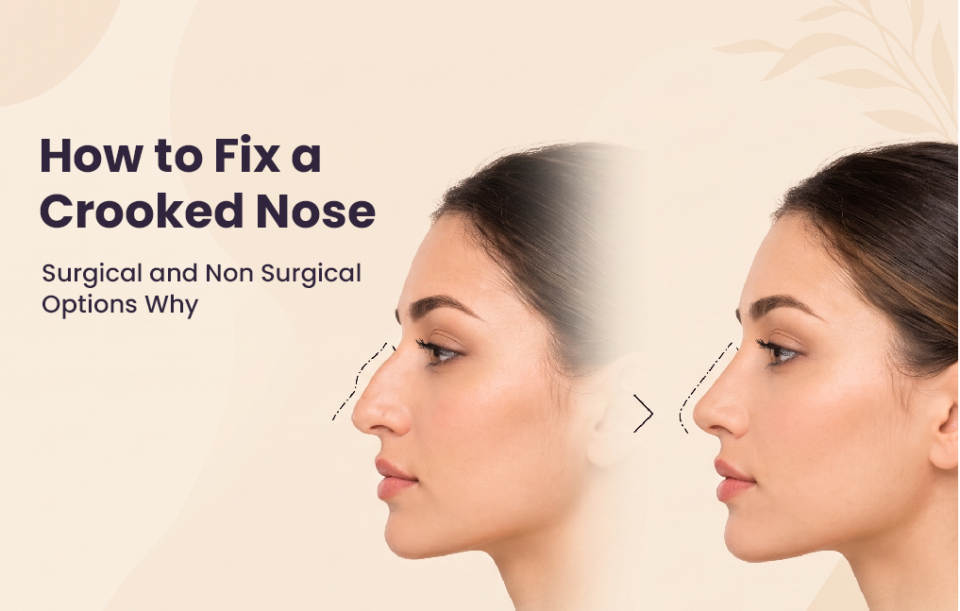
How to Fix a Crooked Nose: Surgical and Non Surgical Options
A crooked nose is one of the most common reasons people look into nose correction. It can be the result of an old injury nobody thought much about at the time, or something that developed on its own as the face grew. Either way, it tends to become more noticeable in photographs than in the mirror.
There are two broad routes to correcting it, and they do very different things. This article explains what each one can achieve, and how to work out which applies to your nose.
What Counts as a Crooked Nose?
Worth saying at the start: almost nobody has a perfectly symmetrical nose. Mild asymmetry is the norm, not the exception, and most of it goes unnoticed by everyone except the person who owns it.
A crooked nose usually means the nose deviates visibly from the midline of the face. Draw an imaginary line from between the eyebrows down to the centre of the upper lip. If the nose sits clearly to one side of that line, or bends away from it along its length, that is a deviation rather than ordinary asymmetry.
The distinction matters because it changes the answer. An asymmetrical nose with minor irregularity often needs very little. A genuinely deviated one usually needs structural work.
Types of Deviation
Surgeons describe crooked noses by the shape of the deviation, because the shape determines the approach.
- C shaped: the nose bends in one smooth curve away from the midline, giving the look of a curved nose
- S shaped: the upper part tilts one way and the lower part the other, which is the hardest pattern to correct
- Straight deviation: the whole nose sits off centre while remaining straight in itself, often described as a tilted nose
- Tip deviation: the bridge is central but the tip points to one side
A bent nose can involve the bone, the cartilage, or both, and which structures are affected decides whether a non surgical approach is realistic at all.
What Causes a Crooked Nose
The nose is built in three layers. The upper third is bone. The middle third is upper lateral cartilage. The tip is shaped by the lower cartilages. Running through the centre is the septum, the wall of nasal cartilage and bone that divides the two sides.
The septum is the key structure. It acts as the central support for the whole nose, so when it is deviated, the external shape often follows it.
- Injury, which is the most common cause. Even a minor knock in childhood can shift the growth pattern for years afterwards.
- Natural growth, where the septum grows unevenly and pulls the nose off centre without any injury involved.
- Previous nose surgery, where healing has not gone as planned and the shape has shifted.
- Birth related deviation, present from the start.
When a Crooked Nose Affects Breathing
This is the part that often gets missed. Because a deviated septum both bends the nose and narrows the airway, many people with a visibly crooked nose also breathe better through one side than the other.
Common signs include one nostril feeling persistently blocked, breathing worsening when lying on a particular side, mouth breathing at night, or recurring sinus trouble.
If breathing is affected, the correction is not purely cosmetic. Straightening the septum, known as septoplasty, addresses the airway, and it is often performed together with external reshaping in the same operation. This is worth raising at consultation even if appearance is your main concern, because it changes how the procedure is planned.
Non Surgical Options: What Fillers Can and Cannot Do
Non surgical correction uses dermal filler placed at specific points along the nose. It does not straighten anything. It adds volume on one side so that the nose reads as straighter to the eye, by softening the visible bend.
For a mild deviation, a small dip along the bridge or a minor irregularity after injury, non surgical rhinoplasty can make a visible difference in a single appointment with no downtime.
What it cannot do is equally important. It cannot move bone. It cannot correct a significantly deviated septum. It cannot improve breathing, and in fact it adds a small amount of bulk to a nose that may already feel narrow inside. It cannot make a nose smaller, only fuller in selected areas. The effect is temporary and fades over time.
There is also a safety point worth knowing. The nose has a dense blood supply, and filler placed here carries more risk than filler in most other parts of the face. It should only be done by a doctor trained specifically in nasal filler anatomy.
Surgical Correction
Crooked nose surgery is structural. Rather than disguising the bend, it repositions the framework underneath so the nose sits on the midline.
Depending on which structures are involved, the surgery may include straightening or partially rebuilding the septum, controlled cuts in the nasal bones so they can be repositioned, and cartilage grafts used to support the corrected shape while it heals. Graft cartilage is usually taken from the septum itself, and sometimes from the ear.
Bent nose surgery of this kind sits under rhinoplasty surgery, and where breathing is also affected the septal correction is carried out in the same procedure.
This is technically demanding work. Bone and cartilage have memory and tend to drift back toward their original position during healing, which is why correcting a crooked nose is generally considered harder than reshaping a straight one.
Comparing the Two Approaches
| Non surgical (filler) | Surgery | |
| What it does | Camouflages the bend | Repositions the structure |
| Suitable for | Mild deviation, small irregularities | Moderate to significant deviation |
| Helps breathing | No | Yes, when the septum is corrected |
| Anaesthesia | Topical numbing | General anaesthesia |
| Downtime | Minimal | Around a week off, longer for full settling |
| How long it lasts | Temporary | Long term |
What Recovery Involves
After surgery a splint is usually worn over the nose for about a week. Bruising around the eyes is common in the first few days and settles within two weeks in most cases.
Swelling takes much longer. The nose looks presentable within a few weeks, but the finer detail continues to settle for many months, and the tip is usually the last area to refine. The rhinoplasty healing timeline sets out what to expect at each stage.
Being Realistic About the Result
The aim of correcting a crooked nose is improvement toward the midline, not perfect symmetry. The face itself is not symmetrical, so a nose that matches it exactly would look unnatural rather than better.
Healing also varies between people. Cartilage does not always settle exactly as planned, and a small proportion of crooked nose corrections need a minor revision later. A surgeon who explains this at the first consultation is giving you an accurate picture rather than a discouraging one.
Frequently Asked Questions
Can a crooked nose be fixed without surgery?
A mild bend can often be camouflaged with filler. A significant deviation, or one involving bone, needs surgery. Filler cannot straighten structure.
Does a crooked nose always affect breathing?
No, but it often does, because the same deviated septum that bends the nose also narrows the airway. It is worth having assessed even if breathing feels normal to you.
Is crooked nose surgery harder than a standard rhinoplasty?
Generally yes. Bone and cartilage tend to drift back toward their original position during healing, so the correction has to account for that.
How long until the nose looks straight?
The broad shape is visible within a few weeks of the splint coming off. Finer detail continues to settle over many months.
Can a nose become crooked again after surgery?
Some degree of shift during healing is possible, which is why a small number of cases need a minor revision. Following aftercare instructions closely reduces the risk.
Talk to a Specialist
Whether a crooked nose needs filler or surgery depends on which structures are deviated and whether breathing is involved. Both are assessed in person, and the answer is often clearer than people expect once the nose has been examined properly.
Navaa Plastic & Cosmetic Surgery is located in Andheri West, Mumbai, where nasal structure and breathing are assessed together before any approach is discussed.


