

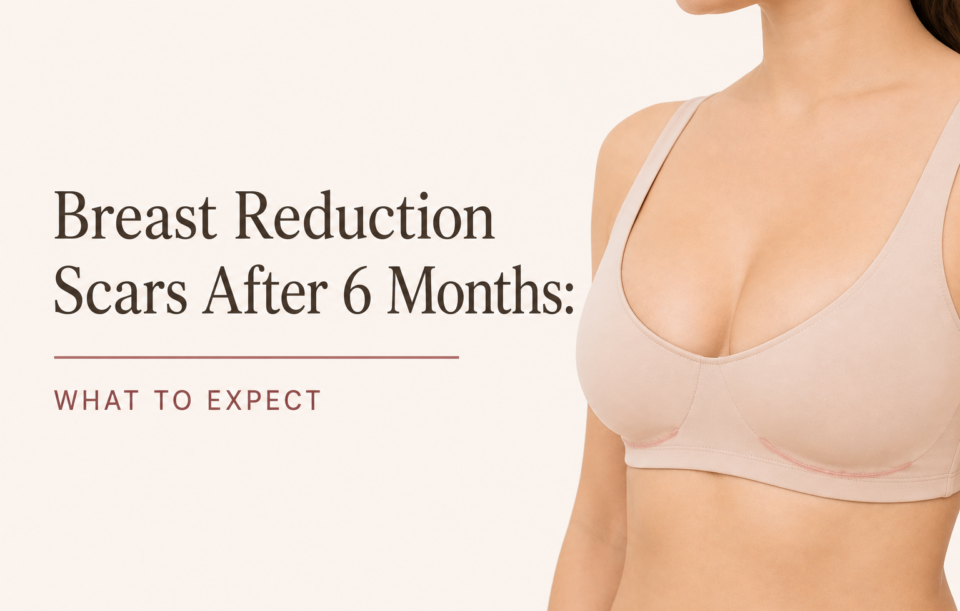
Breast Reduction Scars After 6 Months: What to Expect
If you are six months post-op from breast reduction surgery and still noticing your scars, you are right on track. The six-month mark is a real turning point in scar healing, here is what to expect and what comes next.
Are Breast Reduction Scars Normal at 6 Months?
Yes, completely. Breast reduction scars are a natural result of the surgery. What changes dramatically is how they look over time. By six months, most patients notice scars beginning to flatten and transition from red or pink toward a lighter tone that blends with surrounding skin.
What Do Scars Look Like at the 6-Month Mark?
At six months, you can typically expect:
- Colour — Scars are transitioning from red or deep pink to a lighter, more natural hue
- Texture — Scars begin to flatten and soften noticeably compared to the earlier months
- Firmness — The raised, firm feeling gradually eases as collagen remodelling continues
- Sensitivity — Mild itching or tightness may persist but is generally reducing
This is the scar maturation phase, where the most visible improvement happens. Full maturation continues for up to 12 to 18 months.
The Full Breast Reduction Scar Timeline
Weeks 1–6
Incisions are fresh, red, and swollen. Scars appear raised and firm. Redness persists and itching begins, a sign of active healing.
Months 2–3
Scars start to flatten. Redness softens and silicone scar products can be introduced with surgeon approval.
Months 3–6
Continued fading and flattening. Scars become noticeably less prominent.
Months 6–12
Scars mature and increasingly blend with surrounding skin. Colour lightens further and texture smooths out considerably.
Beyond 12 Months
Ongoing improvement. Scars may never fully disappear but become very faint and discreet.
How to Improve Scar Appearance at 6 Months
Proven approaches to support the best outcome:
- Silicone gel or sheets — highly effective for flattening and fading scars
- Scar massage — gentle daily massage breaks down scar tissue and improves texture
- Sun protection — UV exposure can permanently darken scars; use SPF or cover the area
- Moisturising — hydrated skin softens faster
- Avoid smoking — significantly impairs healing and worsens long-term scarring
What Affects How Your Scars Heal?
Several factors influence how breast reduction scars heal:
- Genetics — your body’s natural healing response
- Skin tone — darker skin is more prone to hyperpigmentation
- Surgical technique — precision of incision and closure
- Post-operative care — how closely instructions are followed
- Lifestyle — nutrition, hydration, and sun avoidance
When to Speak to Your Surgeon
Contact your surgeon if you notice:
- Raised, thickened scars that continue to grow (keloid formation)
- Persistent redness, warmth, or swelling that is not improving
- Significant asymmetry in how the two sides are healing
Will the Scars Be Visible Long-Term?
For most patients, scars fade to thin, pale lines well-hidden within the breast’s natural contours, often invisible in clothing or swimwear.
At Navaa, our surgeons plan incision placement carefully and provide personalised aftercare guidance at every stage of recovery.
Frequently Asked Questions
Q1. Are breast reduction scars permanent?
Scars are permanent but fade significantly. By 12 to 18 months, most scars are very faint and blend naturally with the surrounding skin.
Q2. When can I start scar massage?
Most surgeons recommend beginning gentle scar massage around 6 weeks post-surgery, once incisions are fully healed.
Q3. What is the breast reduction surgery cost in India?
Costs vary based on the extent of surgery and facility. Contact Navaa for a personalised consultation and pricing.
Q4. How long does full scar healing take?
Full scar maturation typically takes 12 to 18 months, though the most significant improvement is visible within the first year.
Have questions about your recovery? The experienced surgeons at Navaa are here to guide you at every stage.


