

Written By
Navaa Team

Reviewed By
Dr. Suraj Nair
About the Reviewer
Dr. Suraj Nair
Dr. Suraj Nair is a Plastic and Cosmetic Surgeon with an M.Ch in Plastic Surgery, M.S. in General Surgery, and M.B.B.S. He specializes in facial aesthetics, body contouring, reconstructive surgery, and surgical and non-surgical cosmetic procedures.
▣
Published on
March 26, 2026
◷
Reading Time
8 min read
Liposuction Hips and Thighs Recovery: What to Expect Week by Week
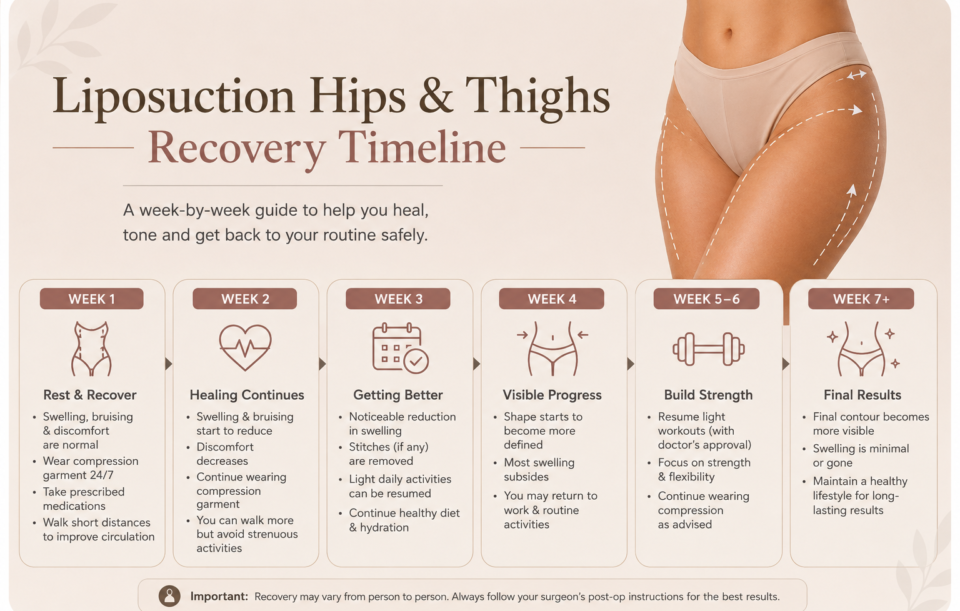
Most patients return to desk work 7 to 14 days after hip and thigh liposuction, resume exercise by week 6, and see final results between months 4 and 6. Because the hips and thighs are weight-bearing areas that move all day, swelling here lasts longer than in areas like the abdomen or chin — and knowing this in advance is the best way to avoid worry during recovery. This liposuction hips and thighs recovery guide explains what happens at each stage: how swelling behaves, when you can sit, work, and exercise again, and when your new shape actually becomes visible.Why Recovery in the Hips and Thighs Takes Longer
Three things make the lower body different: Constant movement. Every step, every time you sit or stand, the treated tissue is working. This keeps mild inflammation active for longer than in a stationary area like the abdomen. Gravity. Fluid naturally drains downward. Swelling in the thighs — especially the inner thighs — settles more slowly because the body has to push lymphatic fluid upward against gravity. Rich lymphatic network. The hips and thighs have high lymphatic activity. This is good for long-term healing, but it means fluid retention is more noticeable in the first few weeks. The result: recovery here is not harder, just slower to look finished. Your body is healing on schedule even when the mirror says otherwise.Hips vs Thighs: They Heal at Different Speeds
Even when treated in the same session — as is common in thigh liposuction combined with hip contouring — these two zones recover differently: Hips have firmer tissue and better circulation. Swelling reduces faster and bruising is usually milder. Inner thighs have thinner skin, softer tissue, and dense nerve networks. Expect more sensitivity to touch in the early weeks and slower skin tightening. Walking can make soreness more noticeable here at first. Outer thighs sit between the two — moderate swelling, moderate sensitivity. This is normal. Do not compare one area against the other and assume something is wrong.Week-by-Week Recovery Timeline
Days 1–3: Rest, Compression, and Short Walks
The most uncomfortable phase. Expect significant swelling, bruising, tenderness, and some fluid leaking from the tiny incision sites — all normal in the first 48 hours.- Wear your compression garment continuously, exactly as instructed. It controls swelling and helps the skin adapt to the new contour.
- Take short, slow walks around the house from day one. This is not exercise — it keeps blood moving and lowers the risk of blood clots (DVT), which matters more in lower-body procedures.
- Keep your legs slightly elevated when resting.
- Prescription pain relief is usually needed only for the first few days.
Days 4–7: Discomfort Starts to Ease
Soreness becomes more manageable, and most patients switch to over-the-counter pain relief with their surgeon’s approval. Bruising often looks worse before it fades — colour changes from purple to green to yellow are a normal part of healing. Continue short walks several times a day and avoid sitting in one position for long stretches.Weeks 1–2: Peak Swelling (“Swell Hell”)
Swelling and bruising peak in this window — patients often call it “swell hell,” and it is the stage where most people panic unnecessarily. What you see in the mirror now is almost entirely fluid, not your result. Some patients even feel the area looks bigger than before surgery. This is temporary.- The treated area may feel tight, firm, or numb. Numbness is expected and fades gradually over the following months.
- Most patients with desk jobs return to work within 7 to 14 days. Physically demanding jobs need longer — your surgeon will guide you.
- Break up sitting every 30–45 minutes with a short walk. Prolonged pressure on freshly treated hips and thighs slows fluid drainage.
- Sleep on your back with a pillow under your knees if side-sleeping puts pressure on treated areas.
Weeks 3–6: The Turning Point
Swelling drops noticeably, bruising fades, and your new hip and thigh contours start to emerge.- Walking becomes comfortable, and light cardio (walking on a treadmill, stationary cycling with no resistance) is often approved.
- The compression garment usually shifts from 24/7 wear to daytime-only, based on your surgeon’s advice.
- Manual lymphatic drainage massage is often recommended from around week 2–3 onwards to speed up swelling resolution — only from a trained therapist and only with your surgeon’s approval.
- If incision points are visible, silicone sheets or scar gels can be started now if advised.
Months 2–3: Visible Change
The majority of swelling has resolved, and the before-and-after difference becomes clearly visible. Light lower-body exercise is usually permitted. Some deep firmness or tightness under the skin is normal — this is internal healing, and it continues to improve.Months 4–6: Final Results Take Shape
Skin retraction completes, remaining swelling fully subsides, and the contour refines into its lasting shape. Skin can continue tightening for up to 12 months, especially in the inner thighs. This is the stage where final results are typically assessed.7 Liposuction Hips and Thighs Recovery Tips That Matter Most
- Compression is non-negotiable. Wear your garment for 4–6 weeks as directed — it is the single most important recovery tool for swelling control and smooth skin retraction.
- Walk daily from day one. Short, frequent walks beat one long walk. Movement drains fluid and protects against clots.
- Avoid prolonged sitting for the first two weeks. Stand and move every 30–45 minutes.
- Cut sodium, increase water. Salt holds fluid; hydration helps flush it out.
- No strenuous lower-body exercise until week 6 — squats, lunges, and running only after surgeon clearance.
- Ask about lymphatic drainage massage. When appropriate, it can meaningfully shorten the swollen phase.
- Protect incision sites from the sun for at least 6 months to prevent the small marks from darkening.
Normal Side Effects vs Warning Signs
Expected and Temporary
- Swelling and bruising — resolve over weeks
- Numbness or altered sensation — fades over months as nerves recover
- Firmness or mild lumpiness — softens as internal healing progresses
- Small incision marks — typically fade significantly within a year (Do liposuction scars fade? Read our detailed guide)
- Minor fluid drainage — normal in the first 48 hours
Call Your Surgeon Promptly If You Notice
- Fever, or increasing redness and warmth around incisions
- Pain that worsens instead of improving after the first week
- One leg significantly more swollen than the other, or calf pain
- A growing pocket of fluid under the skin (possible seroma)
- Any discharge with a foul smell