
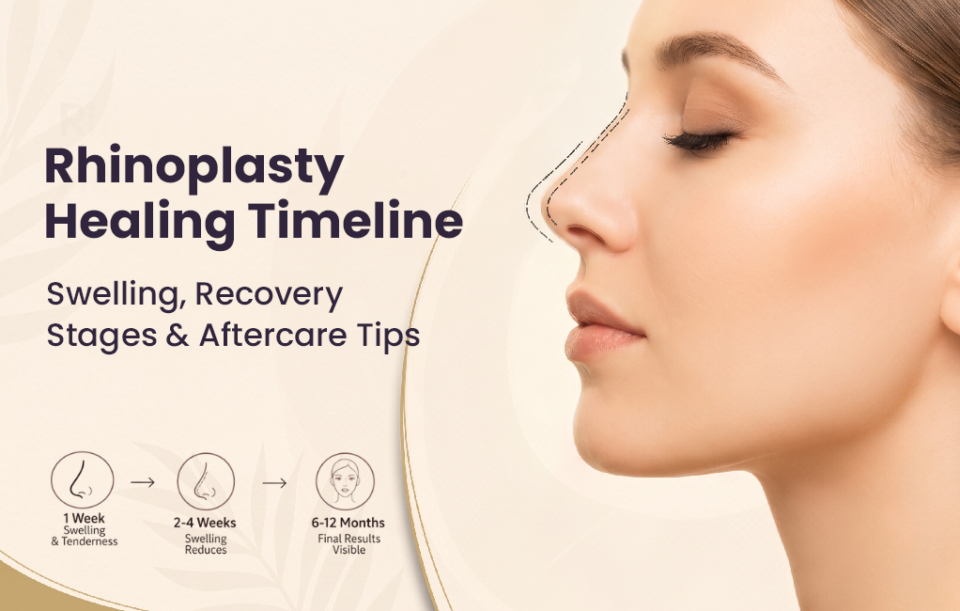

Rhinoplasty Healing Timeline: Swelling, Recovery Stages and Aftercare Tips
Here is the part most patients are not prepared for. The nose you see on the day your splint comes off is not the nose you are going to keep. It is swollen, it sits differently, and it will keep changing for the better over the next several months.
Knowing this in advance saves a great deal of unnecessary worry. Nearly every surgeon will tell you the same thing: the patients who cope best with recovery are the ones who understood the timeline before they walked into theatre, not the ones who went looking for answers on day seven when their nose looked wide and unfamiliar.
This guide walks through what happens at each stage, why Indian patients often follow a slightly longer curve, and which aftercare habits genuinely make a difference.
What Is Actually Healing Inside Your Nose
A rhinoplasty procedure reshapes bone, cartilage and soft tissue. Your body responds to that the way it responds to any surgery, by sending fluid and inflammatory cells to the area. That fluid is the swelling you see.
The nose is also unusual in one important way. Skin on the nasal tip is thicker and richer in oil glands than skin on the bridge, and it sits at the lowest point of the structure. Fluid drains downward under gravity. This is why the bridge looks refined within weeks while the tip stays stubbornly full for months. It is not a surgical error. It is anatomy.
Whether you had an open rhinoplasty procedure or a closed one changes the picture slightly, and so does whether septal work was done at the same time.
Week One: The Hardest Stretch
The first forty-eight hours are the most uncomfortable part of the entire recovery. Expect swelling and bruising around the eyes and cheeks rather than pain in the nose itself. Most patients describe the sensation as blocked and heavy rather than sore, and many are surprised by how little actual pain there is.
You will have an external splint and possibly internal splints or soft packing. Sleep propped up on two pillows, or on a recliner if you have one. Do not blow your nose. Cold compresses go on the cheeks and around the eyes, never pressed directly onto the nose.
Bruising usually peaks around day two or three and then starts fading. Splint removal typically happens on day six or seven.
Be ready for that appointment emotionally. This is the moment most patients find hardest, because the nose looks broad, upturned and nothing like the plan you discussed. That is trapped fluid, not the result. Almost every surgeon has had this conversation hundreds of times.
Weeks Two to Four
Facial bruising resolves. The nose remains clearly larger than it will eventually be, and the tip may feel numb, stiff or oddly firm to touch. Sensation returns gradually over the following weeks and months.
Around week three, nasal breathing usually starts improving. Patients who had a deviated septum corrected during the same nose operation often notice better airflow than they had before surgery, though internal congestion can persist longer when septal splints were used.
Most people return to desk work within seven to ten days, once the splint is off and visible bruising has settled. Anything that raises blood pressure waits longer. Gym, running, weights and swimming generally resume between week four and week six, and only when your surgeon confirms the date.
Months Two to Six
This is when the meaningful change happens. Swelling drops steadily and the bridge begins to look genuinely refined. Friends who did not know about the surgery may simply notice you look different without identifying why.
The tip lags behind. It is the last area to settle in almost every patient, and progress here is measured in months rather than weeks. By the six-month mark, most patients are looking at something close to their final shape.
Many patients experience a dip in confidence around month three, when visible progress slows. This is normal and temporary.
Months Six to Twelve
Around 95% of swelling has resolved by six months, and roughly 97% by the one-year mark. The remaining change is subtle, mostly in tip definition and in how the skin redrapes over the new framework underneath.
Surgeons generally wait a full twelve months before assessing whether any refinement is needed, because tissue must settle completely before a fair judgement can be made.
Why Indian Patients Often Heal on a Longer Curve
This point is missing from most international recovery guides, and it matters if you are healing in India.
Thicker, more sebaceous nasal skin, which is common in Indian and South Asian anatomy, holds swelling longer than thin skin does. Tip definition may take twelve to eighteen months to emerge fully rather than the twelve months quoted in most Western guides. Nothing has gone wrong if your progress feels slower than what you read online.
Climate contributes as well. Mumbai humidity increases congestion during the splint period, and dust exposure while commuting can irritate healing nasal passages. If your surgery falls during monsoon, plan for a slower and more uncomfortable first fortnight and arrange to work from home if you can.
Aftercare That Actually Changes Your Timeline
Keep your head elevated for the first two weeks. This single habit does more for swelling than anything else on this list.
Protect the area from sun. Healing skin pigments easily, and discolouration on the nose is slow to fade. A cap or umbrella is enough.
Hold off on jal neti, saline rinses and any nasal irrigation until your surgeon clears it, usually after splint removal. Starting too early can disturb internal healing.
Avoid glasses resting on the bridge for four to six weeks. Tape them to your forehead or switch to contact lenses if your surgeon agrees.
Ask before starting nasal exercises after rhinoplasty. Taping and massage help some patients and are unhelpful or harmful for others, depending entirely on the technique used in your surgery.
Stay off cigarettes completely. Smoking restricts blood supply to healing tissue and is one of the few factors genuinely within your control.
Call your surgeon promptly if you develop fever, heavy bleeding, sudden one-sided swelling, or pain that increases after day four rather than decreasing.
Frequently Asked Questions
How long until I look normal in photographs?
Most patients feel comfortable in photos around week three to four. Close inspection still shows swelling at that stage.
Is recovery different for open rhinoplasty?
The open technique involves a small incision on the columella, the strip of tissue between the nostrils. This adds mild extra tip swelling, but the overall timeline is broadly similar.
Does septoplasty change recovery?
Internal congestion tends to last two to four weeks longer when septal work is included. Breathing improvement is usually noticeable by week four to six.
When can revision be considered?
Most surgeons wait a full twelve months before assessing revision rhinoplasty, since tissue must fully settle before any decision is made.
Can surgery be avoided?
For minor contour concerns, non-surgical rhinoplasty is sometimes discussed. It does not address underlying structure or breathing.
Will my nose keep changing after a year?
Only very subtly. The nose continues to age like the rest of the face, but active healing is essentially complete.
To discuss a timeline based on your own anatomy and skin type, book an assessment for rhinoplasty in Mumbai with Navaa Plastic & Cosmetic Surgery.


