
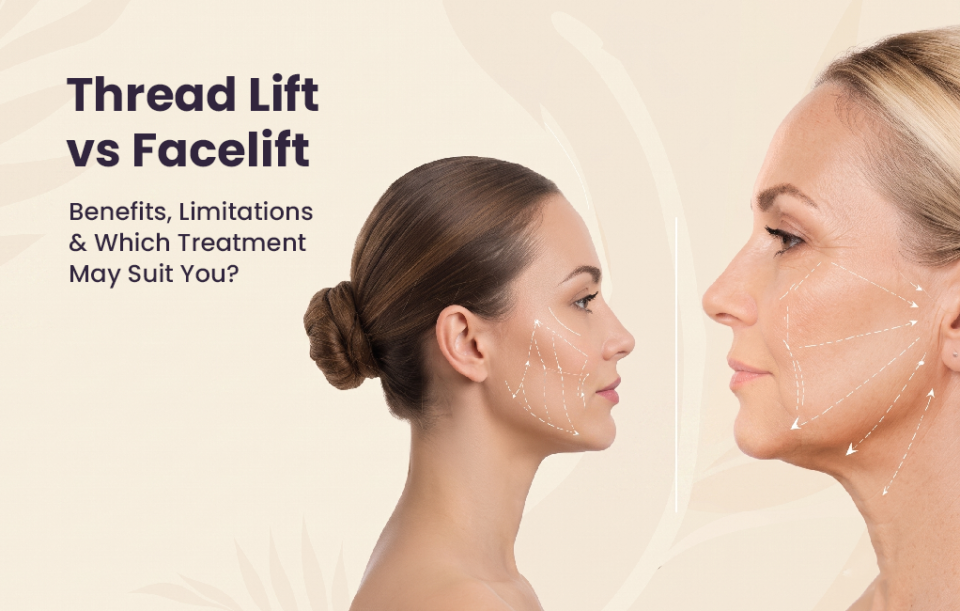

Thread Lift vs Facelift: Benefits, Limitations and Which Treatment May Suit You
As skin loses collagen and elastin, the mid-face and jawline begin to descend. Patients researching face lifting treatment options usually come across two very different answers: a thread lift treatment and a facelift. One is a short in-clinic procedure. The other is surgery. Knowing what each can and cannot do makes your consultation far more useful.
What Is a Facelift?
A facelift, known medically as rhytidectomy, is a surgical procedure that repositions the deeper support layer of the face called the SMAS, then removes excess skin. Incisions are placed along the hairline and around the ear so they settle into natural creases.
Because facelift surgery works on the deep structural layer, it addresses jowls, deep folds and loose skin on the neck. It is performed under general or twilight anaesthesia by a plastic surgeon.
What Is a Thread Lift?
A thread face lift uses dissolvable sutures, usually PDO or PLLA, inserted under the skin through a needle. The threads have small barbs or cones that grip tissue and lift it upward. Over the following months the threads dissolve and stimulate collagen in the treated area.
The thread lift procedure is done under local anaesthesia in about 45 to 60 minutes, with no incisions and no stitches to remove.
Key Differences at a Glance
Factor | Thread Lift | Facelift |
Type | Minimally invasive | Surgical |
Anaesthesia | Local | General or twilight |
Procedure time | 45 to 60 minutes | 3 to 5 hours |
Downtime | 2 to 5 days | 2 to 3 weeks |
Layer treated | Superficial to mid tissue | Deep SMAS layer |
Duration of effect | Around 12 to 18 months | Several years |
Scarring | None visible | Hidden in hairline and around ear |
Repeatable | Yes | Limited |
Benefits and Limitations
The benefits of a thread lift are short downtime, no general anaesthesia, and a subtle change rather than a dramatic one. It suits patients who want to return to work quickly.
Thread lift limitations: the effect is temporary. Threads cannot remove extra skin on the face, and they cannot lift heavy tissue. If laxity is advanced, threads may create puckering or an uneven result rather than a smooth lift.
Facelift benefits: it addresses the underlying cause of sagging rather than repositioning the surface. Because excess skin is removed, it can treat concerns a thread lift cannot reach, including the neck.
Facelift limitations: it is surgery. It carries the risks associated with any operation, requires meaningful recovery time, and is not reversible. It also does not improve skin texture or pigmentation, so patients often combine it with skin treatments.
Which May Suit You?
A thread lift is often considered for patients in their thirties and forties with mild early laxity and good skin quality. It is also chosen by patients who are not ready for surgery and want to see how a lift looks on their face.
A facelift is generally discussed with patients who have moderate to significant sagging, jowling or neck laxity, where threads would not hold. Some patients are advised to treat volume loss first with dermal fillers or fat grafting, since a lift alone does not restore lost volume.
Skin quality, bone structure, degree of laxity and your recovery availability all influence the recommendation. This assessment cannot be done from photographs alone.
Frequently Asked Questions
Can a thread lift replace a facelift?
No. They treat different degrees of laxity. A thread lift works on early sagging, while a facelift addresses the deeper support layer.
How long does each result last?
Thread lift effects typically last around 12 to 18 months. Facelift results last several years, though the face continues to age.
Can I have a thread lift first and a facelift later?
Yes, this is common. Previous threads should be disclosed to your surgeon during planning.
What is the thread lift cost in India?
Cost depends on the number of threads used, the type of thread and the areas treated. Your surgeon will share a written estimate after assessing you. See the note above for current ranges.
Which is safer?
Both carry risk. A thread lift has fewer surgical risks but a higher chance of asymmetry or thread visibility if placement is not precise.
How do I decide?
Book an assessment with Navaa Plastic & Cosmetic Surgery to have your skin laxity examined in person.