


Navaa Team
Written By Navaa Team
Dr. Suraj Nair
Reviewed By Dr. Suraj Nair
About the Reviewer
Dr. Suraj Nair
Dr. Suraj Nair is a Plastic and Cosmetic Surgeon with an M.Ch in Plastic Surgery, M.S. in General Surgery, and M.B.B.S. He specializes in facial aesthetics, body contouring, reconstructive surgery, and surgical and non-surgical cosmetic procedures.
Published on September 5, 2026
Reading Time 3 min read

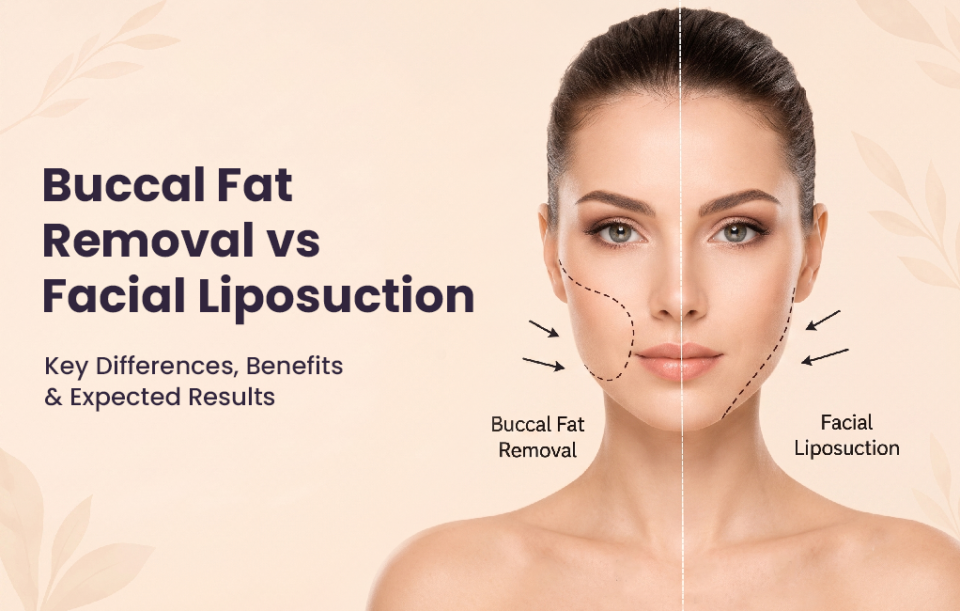
Buccal Fat Removal vs Facial Liposuction: Key Differences, Benefits and Expected Results

Round cheeks can stay round even after weight loss. This is why many people start looking at face fat removal options. Two procedures come up most often: buccal fat removal and face liposuction. They sound similar, but they treat different tissue in different parts of the face. Understanding this difference helps you ask better questions during your consultation.

What Is Buccal Fat?

The buccal fat pad is a deep, encapsulated pocket of fat that sits between your cheekbone and jaw muscles. It is not surface fat. Diet and exercise do not reduce it, which is why some people keep fuller cheeks at any body weight.

Buccal fat removal is a small procedure done through an incision inside the mouth, so there is no external scar. The surgeon removes a measured portion of the pad to create a softer hollow below the cheekbone.

What Is Face Liposuction?

Face liposuction targets subcutaneous fat, the layer that sits just under the skin. A surgeon uses a fine cannula through tiny incisions, usually near the ear or under the chin, to suction fat from the lower cheeks, jawline or neck.

Because it works on the surface layer, facial liposuction can address a wider area than the buccal pad alone.

Key Differences at a Glance

Factor

Buccal Fat Removal

Face Liposuction

Fat layer treated

Deep buccal fat pad

Surface (subcutaneous) fat

Area addressed

Mid-cheek hollow only

Lower cheeks, jawline, neck

Incision

Inside the mouth

Small external incisions

Anaesthesia

Local, usually

Local or general

Typical downtime

5 to 7 days of swelling

7 to 14 days of swelling

Reversibility

Not reversible

Not reversible

Who Is Suitable for Which?

Buccal fat removal may suit you if you are at a stable weight, have good skin elasticity, and your fullness sits high in the mid-cheek. It is generally not advised for very slim faces, because the mid-face naturally loses volume with age.

Face liposuction may be considered when fullness sits lower, along the jawline or under the chin. If skin laxity is the main issue rather than fat, your surgeon may discuss skin-tightening options instead. Some patients are advised to combine both, and some are advised to have neither.

Recovery and Expected Results

Both procedures involve swelling in the first week. With buccal fat removal you follow a soft diet and a saltwater rinse routine while the internal incision heals. With liposuction you may wear a compression garment for a set period.

Final contour typically settles over three to six months as swelling resolves. Results vary from person to person and depend on your facial structure, skin quality and healing response. Your surgeon will explain what is realistic for your anatomy before you decide.

Frequently Asked Questions

Is buccal fat removal permanent? The removed fat does not grow back. However, your face continues to change with age and weight.

Can I have both procedures together? Sometimes, yes. This is decided during an in-person assessment of your fat distribution and skin quality.

Which one gives a sharper jawline? Jawline definition usually responds better to liposuction or chin and jawline procedures, since buccal fat sits higher in the face.

How do I choose? Book an assessment with the team at Navaa Plastic & Cosmetic Surgery to review which layer of fat is causing your concern.