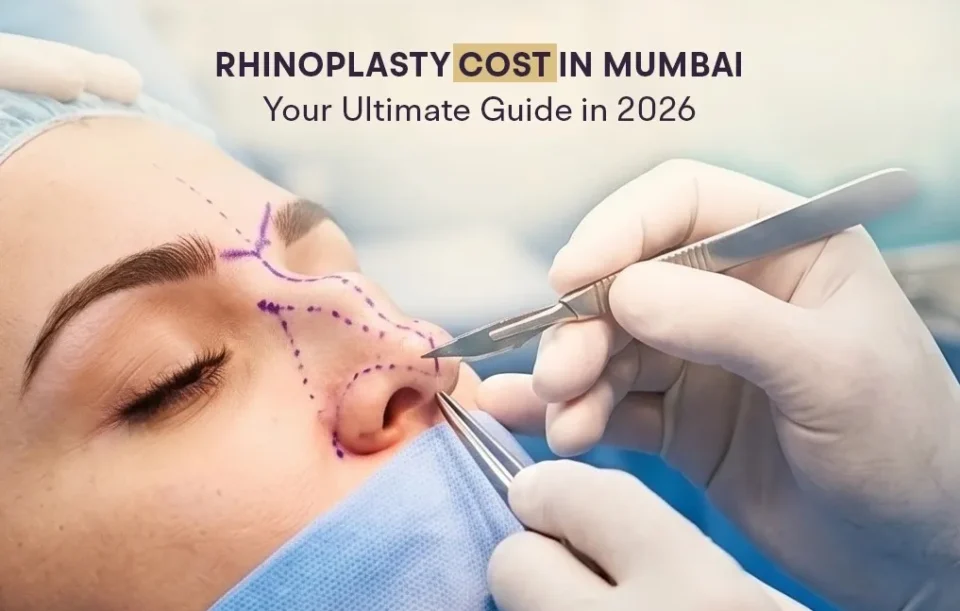

Rhinoplasty Cost in Mumbai: Your 2026 Guide
How much does nose surgery cost in Mumbai? It is the first question most people ask, and it has no single answer. Rhinoplasty is not a fixed-price procedure. Two people can be quoted very different amounts for what sounds like the same operation, because the work involved genuinely differs from one nose to another.
This guide explains what actually goes into rhinoplasty cost in Mumbai in 2026: the factors that move the price, how each technique affects it, what a complete estimate should contain, and how to compare two quotes fairly.
Rhinoplasty cost in Mumbai: what to expect
Rhinoplasty is priced case by case, not from a fixed list. What you pay depends on the technique used, how long the surgery takes, the grade of the facility, whether grafts are needed and whether breathing correction is done at the same time. The sections below explain each of these, so that when you receive a quote you can read it properly instead of comparing headline numbers.
For current starting prices at Navaa Plastic & Cosmetic Surgery, book a consultation. You will receive a written, itemised estimate after an examination.
What affects rhinoplasty cost in Mumbai?
Seven factors account for most of the variation between quotes.
1. Surgeon’s qualification and experience
This is the largest single component of any quote. A surgeon with formal super-specialty training in plastic surgery and years of focused rhinoplasty practice will charge more than a general practitioner offering the same procedure. Nose surgery has a narrow margin for error, and experience is what you are paying for.
2. Whether the surgery is open or closed
Closed rhinoplasty keeps all incisions inside the nose and usually takes less operating time. The open approach takes longer and generally costs more, but for complex reshaping it gives the surgeon more control.
3. Cosmetic only, or combined with breathing correction
If a deviated septum is corrected during the same surgery, the operation becomes a septorhinoplasty. Turbinate reduction may be added as well if the turbinates are enlarged. Either way it means more work and more time, but a single recovery period instead of two.
4. The type of graft used
Septal cartilage is the first choice because it is close at hand. If there is not enough, ear cartilage is next. Rib cartilage gives firmer support than septal or ear cartilage, but it requires a second surgical site, which adds meaningfully to both operating time and cost.
5. Length of surgery and anaesthesia
Operation theatre charges are calculated by the hour, and the anaesthetist’s fee scales with the same clock. Minor tip work can sometimes be done under local anaesthesia with sedation; most full rhinoplasty is done under general anaesthesia.
6. Grade of the hospital or facility
An accredited hospital with a modular theatre, a resident anaesthesia team and emergency backup costs more than a small clinic setup. For any procedure under general anaesthesia, this is not the place to economise.
7. What the follow-up package covers
Rhinoplasty recovery runs over months, not days. Swelling settles gradually and the final shape can take up to a year to appear. A quote that includes a full year of review visits has real value over one that covers two months.
What is rhinoplasty?
Rhinoplasty, commonly called a nose job, is surgery that changes the shape, size or structure of the nose. It is technically demanding work, because the surgeon is dealing with skin, cartilage and bone in a very small space, and every change affects the parts around it. Cosmetic and functional goals are often addressed in the same operation, which affects both the complexity and the billing.
Types of rhinoplasty and how the cost changes
The technique your surgeon recommends depends on your anatomy and your goals. It also has a direct effect on the price.
| Type | What it involves | Relative cost |
| Non-surgical (liquid) | Filler used to smooth a mild hump or lift the tip. No cutting. Temporary. | Lowest |
| Tip plasty | Work limited to the nasal tip. Shorter operating time. | Low |
| Closed rhinoplasty | All incisions inside the nostrils. No external scar. | Moderate |
| Open rhinoplasty | A small incision between the nostrils gives full access for detailed work. | Higher |
| Septorhinoplasty | Reshaping plus correction of a deviated septum in one surgery. | Highest |
Non-surgical rhinoplasty
Also called liquid rhinoplasty, non-surgical rhinoplasty uses dermal filler instead of surgery to camouflage a small hump, lift a drooping tip or improve symmetry. It takes minutes, needs no downtime and costs far less per session. The limits are real, though: filler can only add volume, never reduce it, so it cannot narrow a wide nose or make a large one smaller, and the result fades over months. Only CDSCO-approved fillers should be used, and only by a qualified doctor — the nose has a delicate blood supply and this is not a low-risk injection.
Tip plasty
Only the nasal tip is addressed — refining a rounded or drooping tip, or improving definition. The bridge and nasal bones are left alone, so it is the least extensive surgical option and sits at the lower end of the range.
Closed rhinoplasty
All incisions sit inside the nostrils, so there is no visible external scar. Working through a limited opening restricts what can be done, so this suits patients who need moderate rather than extensive changes. Shorter surgical time keeps the cost lower.
Open rhinoplasty
The open rhinoplasty procedure uses one small incision across the columella, the strip of skin between the nostrils. Lifting the skin lets the surgeon see and shape the framework directly, which matters for detailed reshaping and accurate graft placement. The scar is small and, in most cases, becomes difficult to notice over time. Longer surgery means higher theatre and anaesthesia charges.
Septorhinoplasty
This combines cosmetic reshaping with correction of a deviated septum. It is chosen by patients who dislike the appearance of their nose and also struggle to breathe through it. Two problems, one anaesthesia, one recovery.
Rhinoplasty surgery cost in India: how Mumbai compares
Mumbai generally sits at the higher end of rhinoplasty surgery cost in India, alongside Delhi. Property rents, accredited facility charges and specialist fees are all higher in metro cities than in tier-two centres.
What you gain is access to surgeons who perform nose reshaping surgery regularly rather than occasionally, and to hospitals properly equipped for general anaesthesia. Volume matters in a procedure this technical.
What a proper quote should include
Ask for an itemised estimate covering all of the following. If an item is missing from the quote, it will usually appear on your bill later:
- Surgeon’s professional fee
- Anaesthetist’s fee, which is billed separately in most hospitals
- Operation theatre and day-care admission charges
- Grafts or implants, if required
- Pre-operative blood tests and any imaging
- Splints, dressings and post-operative medicines
- Follow-up consultations, with the number and period clearly stated
Is rhinoplasty covered by insurance in India?
Purely cosmetic rhinoplasty is generally excluded. Cosmetic surgery is a standard exclusion in almost every health policy sold in India.
The picture changes when the surgery corrects a documented functional problem. A deviated septum that blocks breathing, a nasal injury, or a deformity present since birth may qualify, fully or in part. Where cosmetic reshaping and functional correction happen in the same operation, insurers usually consider only the functional portion.
What decides the outcome is documentation. Insurers typically look for:
- A clinical record of the breathing problem over time, not just a mention at the pre-surgery visit
- Evidence that non-surgical treatment was tried first, where that applies
- An ENT or specialist opinion
- Imaging or a nasal endoscopy report, if the insurer asks for it
Apply for pre-authorisation before your surgery date. A claim filed afterwards is much harder to argue. Also check the waiting period in your policy, since many policies do not cover such procedures in the first two to four years.
Coverage depends entirely on your policy wording and your insurer’s assessment, so confirm with your insurer in writing rather than relying on a general rule.
Costs people forget to plan for
- Time away from work — most people need one to two weeks before they are comfortable in public.
- Travel for follow-up visits, especially if you are coming from outside Mumbai.
- Repeat sessions for non-surgical rhinoplasty, since filler results are temporary.
- An additional specialist opinion or imaging, if a breathing problem is suspected.
Choosing a rhinoplasty surgeon in Mumbai
Cost should not be your first filter. Use this checklist when shortlisting a rhinoplasty surgeon in Mumbai:
- Verify the qualification — look for an M.Ch. or DNB in Plastic Surgery, and confirm registration with the NMC or the relevant State Medical Council.
- Ask how often the surgeon performs rhinoplasty and whether the nose is a regular part of their practice.
- Review consented before-and-after photographs of patients whose nose and skin type resemble yours.
- Confirm the surgery will be done in an accredited facility with a qualified anaesthetist present.
- Ask what happens if a minor revision is needed later, and get the answer in writing.
- Notice how the consultation is run. A careful surgeon examines your breathing, explains limits, and tells you what your anatomy will and will not allow.
If one quote sits far below the others, ask what has been left out. The difference is usually the facility grade, the anaesthetist’s qualification, or the length of the follow-up period. Correcting a poor result costs considerably more than getting it right the first time.
Frequently asked questions
Is rhinoplasty covered by insurance in India?
Purely cosmetic rhinoplasty is generally excluded. If the surgery corrects a documented functional problem, such as a deviated septum or an injury, part of it may be considered. Apply for pre-authorisation before your surgery date, not after. See the insurance section above for the full picture.
Which costs more, open or closed rhinoplasty?
Open rhinoplasty usually costs more because it takes longer and is chosen for more complex reshaping. The right technique is decided by your anatomy and your goals, not by price.
Is non-surgical rhinoplasty a cheaper alternative to surgery?
It costs less per session, but the effect is temporary and repeat treatments are needed. Over several years the cumulative cost can approach that of surgery, and it still cannot achieve what surgery can.
How long before I can return to work?
Most people with desk-based work return around two weeks after surgery, once the splint is removed and visible bruising has faded. Physically demanding work needs longer. Your surgeon will advise based on your case.
Planning your next step
A headline number tells you very little on its own. Two quotes are only comparable once you know the technique, the facility, the anaesthesia, the graft and the follow-up period behind each one.
If you are considering rhinoplasty in Mumbai, begin with an examination of both the appearance and the function of your nose, followed by a written, itemised estimate.
At Navaa Plastic & Cosmetic Surgery, you can book a consultation to discuss your options with a qualified plastic surgeon and understand what you are paying for before you decide anything.


